

Xinjiang Cotton 新疆棉
Xinjiang cotton traces its origins to Asiatic cotton introduced during the Han and Jin dynasties (汉晋). Over centuries, cultivation evolved from regional agriculture into a highly structured, independently bred system.
Today, Xinjiang stands as the structural center of China’s cotton production. Its position is built on environment, genetic control, and technical precision.
Archaeological discoveries at Yuli Yingpan and the Astana Tombs in Turpan reveal cotton seeds and textiles dating back to early dynastic periods. By the Tang dynasty, cotton cultivation and textile production were established. Records from the Yuan era document expansion across northern Xinjiang.
In the modern era, long-staple varieties were systematically developed through domestic breeding programs. Over time, independent seed development replaced reliance on external varieties. Long-staple cotton grown in Xinjiang today is entirely self-developed.
This is not imported fiber. It is engineered, refined, and controlled at the genetic level within its own agricultural system.
Origin
Xinjiang’s natural conditions shape the fiber.
Annual sunshine ranges between 2,500 and 3,500 hours. Large day–night temperature shifts slow fiber formation, increasing density and strength. Dry air and low rainfall reduce disease pressure. Long frost-free periods allow full maturation. The result is cotton that is white in color, high in tensile strength, and long in staple length. A high proportion qualifies as Grade 1 or Grade 2. Its long-staple fiber stands alongside Egyptian and Pima cotton in length and strength.
Environmental Structure
Independent Seed Development
The majority of cotton varieties planted in Xinjiang are independently bred. Long-staple cotton varieties are fully self-developed. Key cultivars are selected for early maturity, high yield stability, disease resistance, and compatibility with mechanical harvesting. Breeding control allows consistency across large-scale production and protects fiber characteristics over time.
Genetic autonomy is structural power.
Cultivation and harvesting are highly mechanized across the entire cycle. Modern techniques such as dense early planting with mulching and drip irrigation under film enhance stability while preserving fiber integrity.
The system is designed for repeatable structural quality.
Not seasonal variation.
Not marketing cycles.
Structure.
This is the backbone we choose to build on.
Agricultural System
Xinjiang Cotton Declaration

Fabric Testing Report


Every piece is embroidered in Zhongshan, Guangdong, one of the original homes of Yue embroidery (粤绣), a tradition that stretches back over 1,200 years in that region. Our embroidery is machine-done. The loose threads are intentional. They're meant to stay, meant to fray over years of wear.
Setup before a run. Placement coordinates are set manually for each production batch. When we updated the care label size for I MADE it, the operator caught that the embroidery coordinates hadn't been adjusted, before the full batch ran.
The finished "I MADE it" embroidery. The loose ends aren't a defect. They're left deliberately, the way the thread settles and frays over time is part of how the piece ages with the wearer.

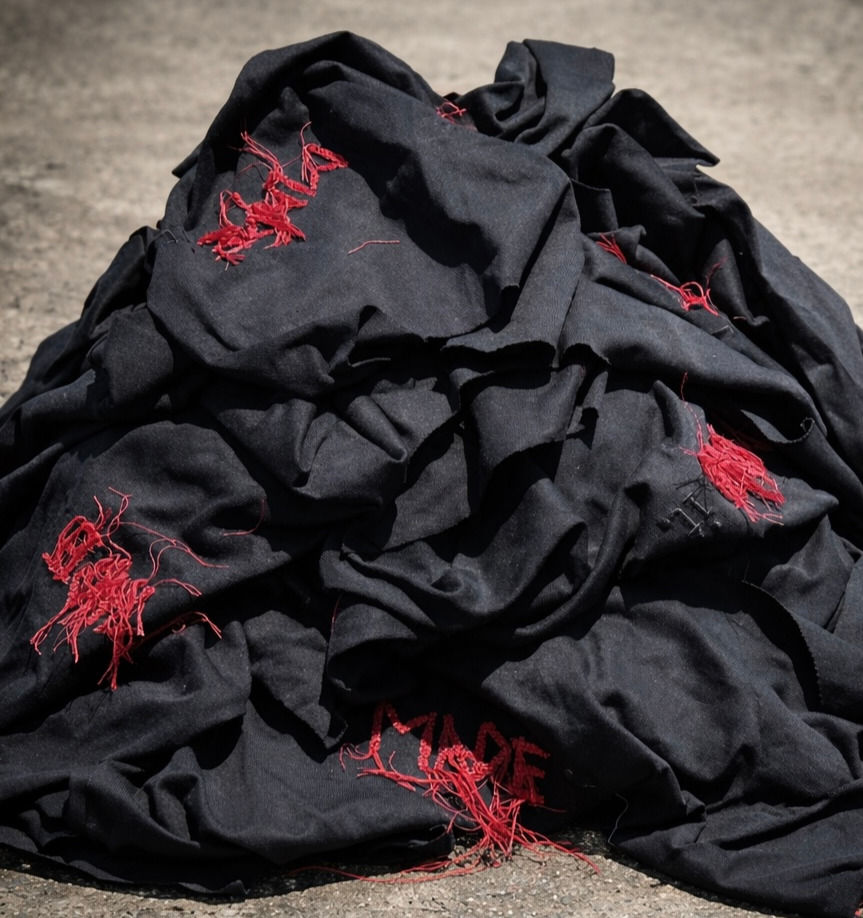
33 pieces out of 240 were pulled at the factory before they left Zhongshan. Not because we asked. Because that's what our production team does.


